Skip to content



1. Introduction: Why do the same attacks still work so well?
Even with significant technological advancements and increased attention to digital security, cyberattacks continue to affect companies with alarming frequency . Moreover, they continue to exploit vulnerabilities that the market has known about for years.
A 2025 study conducted by Grant Thornton , in partnership with the Opice Blum , reveals that 79% of Brazilian companies feel more exposed to cyberattacks.
This data reflects a common paradox : even with increased investment in protection, many organizations still operate with gaps in their controls. This includes weak access points, endpoints without continuous monitoring, and/or prevention policies that have not evolved at the same pace as the risks.
It is in this scenario that the most frequent attacks continue to function. And not because they are new or unknown, but because they exploit points that remain unprotected .
In this article, we will analyze types of cyberattacks that deserve immediate attention and understand why they still represent concrete risks , even for companies that already have some security infrastructure.
Happy reading!
2. Ransomware : data hijacking with a direct impact on business.
Among the most recurring attack vectors in corporate environments, ransomware continues to lead in impact. It is a type of malware designed to block access to essential systems and data, demanding a ransom payment to restore operation.
Its most common method involves encrypting strategic files , such as databases, servers, and critical applications. Then, the attacker displays a message with payment instructions , usually in cryptocurrencies, which makes tracking difficult.
In recent scenarios, ransomware has operated on two fronts: in addition to encrypting data, it also copies sensitive data and threatens to release it publicly , even after payment. This approach, known as double extortion , increases the pressure on the company and raises the risks of damage to its reputation and regulatory compliance.
Sectors with high availability dependence , such as Finance, Healthcare, Logistics, and Retail, are especially sensitive to the impact. In many cases, system unavailability lasts for hours or days, compromising the entire operation and service chain.
This type of attack is rarely isolated . In many instances, ransomware is merely the endpoint of a process that involved lateral movement within the network, privilege escalation, and prior access through other means. One of these, as we will see below, is phishing .

3. Phishing : the attack that starts with a click and opens critical doors.
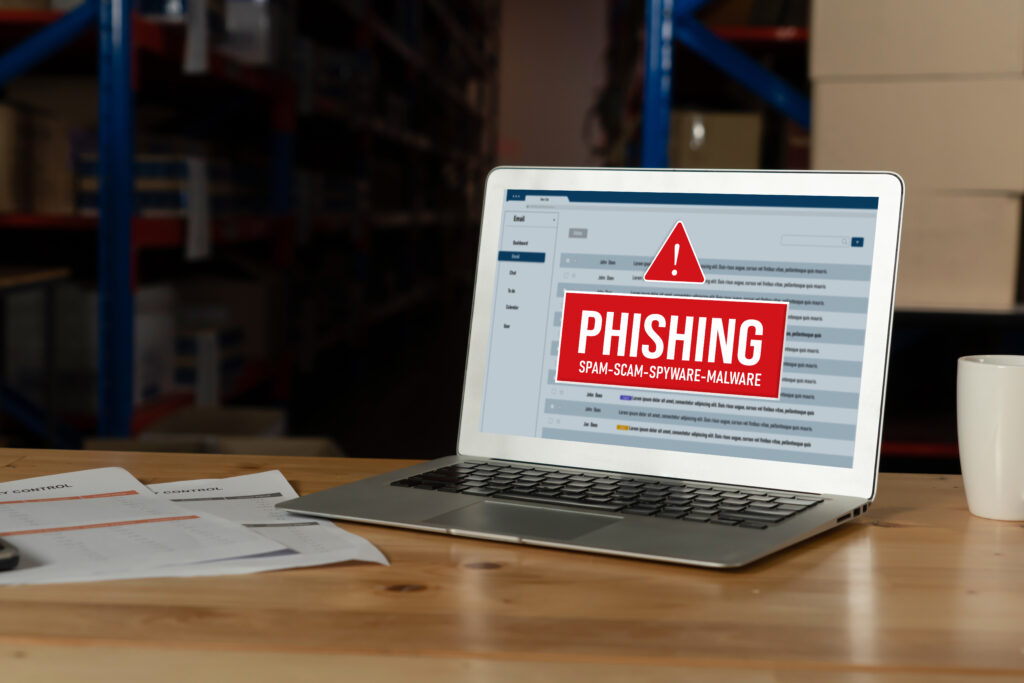
Phishing one of the most common entry points for cyberattacks in companies. By simulating legitimate communications , it deceives users and bypasses technical barriers, facilitating unauthorized access to information and systems, often without raising immediate suspicion.
This type of threat exploits human factors : fragmented attention, overconfidence, or contexts of urgency. emails , messages, or websites mimic well-known suppliers, colleagues, or platforms, using logos, real names, and language tailored to the company's profile. A single action , such as clicking, replying, or downloading, is enough to compromise security.
Some variations help to illustrate the current sophistication of these attacks:
- Spear phishing : emails tailored to specific sectors or profiles;
- Whaling : messages targeted at executives and decision-makers;
- Smishing and vishing : approaches via SMS or calls with a strong emotional appeal.
More than just an isolated scam, phishing often serves as a starting point for more structured attacks . With legitimate credentials in hand, attackers can escalate access, move laterally within the environment, and prepare more serious actions, such as data hijacking or the installation of persistent malware
Therefore, identifying and mitigating this type of threat is essential. Next, we move on to another risk that often remains active for long periods before being detected: malware .
4. Malware : the silent infiltration that exposes data and systems.
While attacks like phishing seek to deceive users directly, malware operates behind the scenes . It is software designed to install itself invisibly, remain active, and interact with the system in ways that benefit the attacker , without triggering defenses from the outset.
Its function can range from the silent collection of information and device mapping to the modification of permissions or manipulation of internal processes. In many cases, it serves as a basis for prolonged persistence in the environment , facilitating new breaches or enabling coordinated attacks.
Entry points are multiple: compromised attachments, unsafe downloads websites , or unpatched vulnerabilities in software . Once inside, the malware operates discreetly , logging commands, opening external connections, or activating specific functionalities without visibly interfering with daily routines. Some examples include:
- Trojans , which disguise themselves as software to open backdoors in the system;
- Spyware , which silently monitors activities and collects confidential data; and
- Keyloggers , which record everything that is typed, such as passwords and sensitive login information.
Its most recent variations incorporate techniques that make tracking difficult , such as code fragmentation, on-demand execution, or disguises within seemingly legitimate updates.
The threat of malware lies precisely in its continuity . The longer it remains undetected, the greater the risk of data exposure, leakage of strategic information, or destabilization of critical services.
In contrast, the next type of attack is explicit in its intention: to stop everything at once. Keep reading to find out!
5. DDoS: Overloading as a strategy to paralyze systems
Unlike silent attacks, DDoS ( Distributed Denial of Service ) act explicitly : their goal is to take applications offline by exploiting the capacity of the digital environment itself. The impact occurs when a large number of simultaneous requests are directed at servers, networks, or services until they stop responding .
These requests originate from distributed devices , often infected and remotely controlled, forming networks called botnets . When activated, these machines overload the infrastructure with automated traffic , preventing legitimate use by customers and employees.
The interruption, in these cases, can last minutes or extend for hours , affecting websites , ERP systems, APIs, customer service portals, and other critical channels. Companies that operate with online , financial services, or real-time support feel the immediate impact on revenue, image, and customer experience.
What makes DDoS attacks even more dangerous is their use as a distraction . There are records of attacks where denial of service serves only as a facade, while, in parallel, an intrusion or data extraction takes place. Thus, system failures cease to be the central problem and become the trigger for something bigger .
By compromising availability, one of the pillars of cybersecurity, DDoS attacks expose operational vulnerabilities and jeopardize both business continuity and customer trust .
And, if we've been talking about external threats so far, it's important to remember: often, the most critical risks are within the organization itself. That's the next point in our content.
6. Internal threats: flaws and unauthorized access that compromise security
When discussing cyberattacks, attention usually focuses on external agents. However, a significant portion of incidents originate within the company itself . These so-called insider threats can have different origins: unintentional errors, unsafe daily practices, or, in more critical situations, the deliberate actions of someone with authorized access.
Malicious intent isn't always present. Often, risks arise from poorly structured processes , such as excessive permissions, active credentials after employees leave the company, or outdated devices. These oversights create loopholes that can be exploited quickly and are difficult to trace. In other cases, the problem lies with users who improperly use privileges to manipulate data, copy confidential files, or even compromise operations.
The complexity lies precisely in the fact that these accesses originate from within. Because they are carried out with legitimate credentials, they don't immediately seem suspicious, making their detection more challenging. This is why models like Zero Trust are gaining traction: instead of automatically trusting any access, each interaction should be continuously validated. In addition, behavioral monitoring helps identify anomalous patterns, such as attempted access outside of business hours or unusual data movements.
These measures do not eliminate the risk, but they drastically reduce the window of exposure . More than recognizing the threat, the challenge lies in building resilience to deal with it at scale. And that is the next step in our analysis: how to transform isolated practices into a consistent defense strategy.
7. How can we strengthen our defenses against constantly evolving attacks?
Attacks are constantly evolving, so defenses need to keep pace. Resilient companies are those that treat security as a living operation , continuously adjusting to changes in the business and the digital landscape.
To achieve this, several layers of cybersecurity are essential:
- SOC ( Security Operations Center ) : continuous monitoring to identify anomalies and respond to incidents in real time;
- EDR ( Endpoint Detection and Response ) : active protection on devices, with detection of suspicious behavior and immediate blocking;
- Intelligent and validated backups : encrypted copies that are periodically tested to ensure reliable recovery in the event of critical incidents;
- Recurring vulnerability analysis : anticipating risks and correcting flaws before they are exploited;
- Zero Trust and access governance : application of the principle of least privilege, with constant validation, including for internal users;
- Strategic awareness : trained and engaged teams, reducing risks linked to social engineering and bad practices in daily operations.
At Skyone , we bring these pillars together in an integrated ecosystem that simplifies security management without sacrificing technical depth. With SOC, EDR, threat analysis, backups Zero Trust- based governance , we support companies in building defenses that anticipate risks, accelerate responses, and maintain the trust needed to grow in an increasingly challenging digital environment.
If you are looking to elevate the maturity of your operation and prepare your company for the next cybersecurity challenges, talk to a Skyone specialist . We are ready to support your journey with complete solutions and a long-term vision!
8. Conclusion: safety is an ongoing process
With each new incident, it becomes clear that the vulnerability lies not only in the sophistication of the attacks, but also in the speed at which they reinvent themselves . This speed makes security a continuous effort that needs to renew itself along with the digital environment and the business models themselves.
In this scenario, the challenge for companies is not to eliminate risk, but to build defenses that evolve at the same speed . And this requires a consistent strategy that unites technology, processes, and people around the same objective: maintaining continuity with security .
At Skyone, we understand that cybersecurity cannot be merely reactive: it needs to be part of the business strategy , supported by continuous monitoring, intelligent threat analysis, and access governance that keeps pace with business growth. This vision allows us to move forward with confidence, without sacrificing innovation and efficiency.
In short, security is not a destination, but a movement. And in this movement lies the opportunity to mature processes, strengthen teams, and create companies better prepared for tomorrow.
Want to continue this reflection? For that, we also recommend reading this other article: Cybersecurity: how to protect your company's data in the digital age .