Skip to content



Regardless of company size, whether small or large, cloud security is always a concern. With the number of cloud environments growing and demonstrating their advantages, cyberattacks are also occurring more frequently . According to The State of Cloud Security, 79% of Brazilian companies operating in the cloud have suffered from this recently.
In the current scenario, it has become common for companies to undertake digital expansion without a consistent and efficient security policy . This raises the crucial question: how to merge cloud security with investments in this area? You'll find the answers below!
Enjoy your reading!
Why are companies migrating to the cloud?
Before we even talk about cloud security, it's interesting to understand why cloud computing is booming. You probably already know that this resource is gaining ground and optimizing businesses, but what are the reasons for this?
From cost reduction – achieved in various ways within the company – to a notable gain in productivity, the cloud offers several advantages that you can take advantage of. Check out some of the main ones below:
Cost-benefit
Potentially leading to cost reductions of up to 70% , this is one of the key benefits for companies choosing the cloud. And the best part is that the cost-effectiveness of cloud computing is due to more than one reason.
First, we should consider the cost reduction from not needing a local server; in other words, the company reduces expenses on machinery, energy, software, and also on the IT team . Furthermore, it's worth remembering that the cloud is a type of outsourced service, where the provider is responsible for keeping everything running .
Predictability of expenses
In the cloud, it works like this: you pay exactly for the service you contract . When choosing a certain amount of cloud storage space, the company relies on it, without surprises regarding other expenses such as updates and maintenance.
Scalability
In addition to cost forecasting, scalability ensures the possibility of changing the size of the cloud . That is, if the business needs more space – or even less – the service can be modified to meet current demands.
This is a crucial point for those who understand that the company will grow over time. With the cloud, you won't be stuck with what was initially planned, and you can easily adapt it to new situations .
Availability
The internet has brought much greater access to the resources we need, and the cloud works exactly the same way. Cloud applications and information are available to virtually any device with an internet connection, working anywhere and at any time .
With work becoming increasingly adaptable to employees' needs, with a rise in remote work and flexible hours , having a business that offers availability is fundamental.
High performance
In the cloud, backups are optimized, ensuring that everything will function as expected. Software operates at high performance, guaranteeing that productivity is maintained and likely maximized.
Working with the largest cloud service providers, such as AWS, Google Cloud, and Microsoft Azure, guarantees 99% uptime . Here you can be sure you won't experience any downtime issues!
Automatic update
As we mentioned earlier, cloud concerns are minimal. The system is managed by the provider, allowing the company to focus on strategic business matters.
System updates and any necessary maintenance are handled by the provider , so you won't be surprised by demands that would require specialized labor and money.
Cybersecurity
Finally, we have the main theme of this text: cloud security. Although nothing on the internet is 100% secure, cloud services do offer significant protection.
Data encryption, firewall protection barriers, and various other security measures are and should be applied to these services. Since this is the subject of our text, you will learn more about some of these features later on.
Data security in the cloud: is the cloud really secure?
Yes, the cloud is safe!
As explained by Caetano Notari, product manager at Skyone, in episode 5 of Sky.Cast, Skyone's podcast:
“No one has larger security teams than Microsoft, Amazon, and Google. Therefore, no data center will have the same level of security, since they have teams working 24/7 focused on maintaining the security of the hosted data“.
It is important to highlight that, even if a good provider takes all necessary precautions to ensure cloud security, it is not possible to guarantee that problems will not occur at some point.
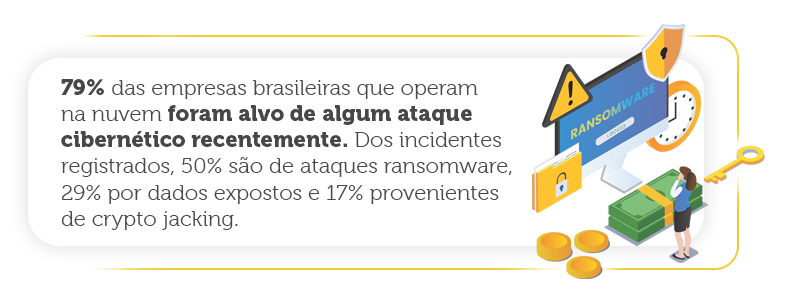
As we mentioned at the beginning of the text, according to The State of Cloud Security , 79% of Brazilian companies operating in the cloud have been the target of some type of cyberattack recently. Of the incidents recorded, 50% are ransomware attacks, 29% involve exposed data, and 17% are cryptojacking attacks.
This happens not only in relation to the cloud. We've already seen news reports of hackers coordinating a ransomware cyberattack that affected nearly 100 countries and managed to hijack data from giant companies. Therefore, nothing is completely foolproof.
The fact is that you can't prevent all threats, but you can monitor them. And the first step is to use automated control systems that quickly detect irregular data patterns and signal that an intrusion is taking place.
When this notification occurs simultaneously, the company can respond quickly and efficiently to the incident to stop the attack and minimize damage.
Cloud-based systems also typically include environmental protection through firewalls and security groups, strong password enforcement mechanisms, constant application of security updates to the operating system, and isolation of the ERP environment from the most common attack vectors, among other measures.
Historical data, logs, and alarms for anomalies in data entry: these are some of the features that make a system intelligent for protection. With well-defined action and reaction protocols for breaches, you can quickly identify a vulnerability and act before the damage becomes truly detrimental to the company.
At Skyone , we developed Skyone Autosky Defender , which is a solution for monitoring and mitigating brute-force attacks.
Developed by the R&D department, it performs real-time monitoring of all unapproved access attempts on Skyone Autosky scaling instances. Based on this information, it blocks all IPs considered to be offending.
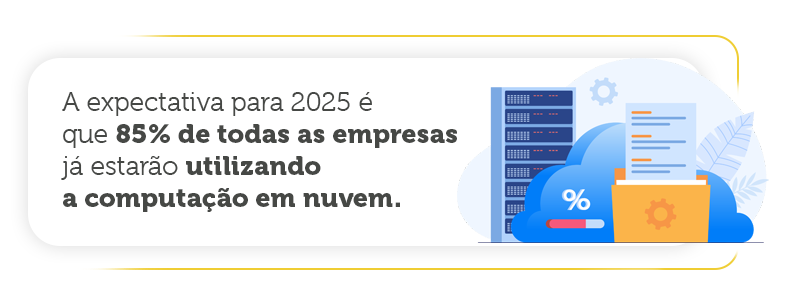
As cloud services continue to grow, it's crucial to remain vigilant about security. To give you an idea, according to data from a Gartner/IDC study, the expectation for 2025 is that 85% of all companies will be using cloud computing .
How can you ensure data security in the cloud?
Given the threats that cloud-based systems and applications can face, check if your cloud service provider offers some of the features listed below to enhance your company's security.
1- Advanced Firewalls
With the mission of monitoring network traffic, firewalls are essential resources for data and application security. However, generally the simplest ones are used, performing only the inspection of source and destination data.
Therefore, opting for more advanced firewalls guarantees that the integrity of the content and the possibility of security threats will also be verified through a more thorough scan.
2- Intrusion detection
As we have seen, due to its remote availability and accessibility on any machine, many users can access the cloud-based system.
Thus, a robust and qualified security system can establish multiple levels of access detection, identifying such users and preventing intruders from bypassing the network's initial defenses.
3- Event logs
This functionality is necessary for predictive and preventative analysis of potential intrusions, since the logs will help analysts understand the flow of access to the system and understand how threats can occur and through what paths.
Thus, the logs create reports and histories about all events on the network, which helps in the search for solutions that prevent and block cyberattacks.
4- Data encryption
Data encryption is a rigorous data security protocol in the cloud, as it ensures that access to certain information is limited to authorized individuals.
Thus, if an intrusion attempt occurs, the hacker will be prevented from accessing the files due to lack of access to the key. The method will also protect against unauthorized access by the cloud service provider itself, as well as the environment administrators.
5- Physical security
Data security in the cloud is far more efficient than in more traditional data storage models, such as local data centers. Therefore, completely migrating your systems and applications to the cloud means gaining 24/7 monitoring by qualified professionals who will constantly verify the security of your system.
Furthermore, it is necessary to reinforce the internal commitment of employees and the IT team to the security policy. Therefore, it is essential to train and update them on the most frequent threats and how they can be avoided.
There are several systems that are widely used when discussing cloud security. Here are three of them:
Zero Trust
As the name suggests, this is a measure that truly applies zero trust. This is a solution that manages access to your company's resources, having a very rigorous system for it.
At Zero Trust, a thorough evaluation is performed before a new connection is made within their system, even if it's not the user's or device's first time. Their motto is "never trust, always verify" .
Security Manager
Security Manager is now more focused on addressing system vulnerabilities , providing comprehensive and routine monitoring. You receive a cybersecurity platform responsible for managing your risk control , identifying potential problems and the best way to resolve them.
SOC (Security Operation Center)
Translated from English as Security Operations Center, this is yet another platform that enhances your cloud experience. Through a combination of solutions, it aims to prevent, detect, analyze, respond to, and evaluate incidents .
The idea is to provide more comprehensive coverage of problems, considering the before, during, and after stages. In this way, the risks to your cloud operations become even smaller.
6- EDR Solutions
Most cyberattacks begin at an endpoint (which can be a computer, tablet, or even a smartphone) and quickly spread throughout the network. Therefore, the EDR solution was created to identify and act rapidly when an intrusion is detected at any of the company's endpoints.
By 2026, global investment in endpoint security $17 billion
Quite similar to EDR, XDR is an extended detection and response . The main difference between the two is that the latter performs a connection and integration process with databases , which makes it possible to understand a greater number of threats and reduce the response time to emerging problems.
Data security in the cloud and compliance with the LGPD (Brazilian General Data Protection Law)
Investing in cloud data security also aims to comply with the guidelines of the General Data Protection Law, in effect since 2021, and with its regulatory body, the ANPD , already in operation.
This is because data breaches can result in various penalties depending on the severity of the breach, reinforcing the importance of seeking a cloud provider that can guarantee your company's security in the cloud and that is attentive to the provisions of the LGPD (Brazilian General Data Protection Law).
Among the penalties foreseen are: warning, simple fine of up to 2%, fine of up to 50 million reais, daily fines, blocking of personal data, blocking of access to data, and even suspension of the core activity related to the use of the data.
In other words, depending on the size and structure of the company, a penalty under the LGPD (Brazilian General Data Protection Law) could mean the bankruptcy of the business.
How does Skyone help companies with data security in the cloud?
By structuring and implementing the best cloud security practices available on the market, at Skyone we focus on ensuring that cloud environments are always secure, both for our clients and for their partners and employees.
Skyone Autosky , one of our solutions, for example, encrypts all data and incorporates an Authentication Layer that securely isolates the ERP system, eliminating the need for VPNs and similar solutions.
Skyone Autosky authentication includes audit logs. The record of each session made by a user and the stored data are useful for internal company audits regarding the use of ERP systems by their employees.
In this way, we create validation routines and vulnerability tests to identify weaknesses and the need for constant improvements, as the hackers themselves evolve their methods.
Furthermore, we offer solutions that help companies innovate and modernize their IT infrastructure securely and efficiently, providing sophisticated cloud migration platforms and services, as well as systems integration.
To that end, we have a specialized team ready to assist the entire ecosystem of partners and clients, available 24/7 in three different languages.
Skyone Autosky: A platform that simplifies the migration and management of cloud-based software
The cloud is a resource that's truly here to stay. After all, besides the incredible numbers that demonstrate its growth, the benefits it brings to a company are vast and are enabling them to grow even more. However, despite being a great platform, it's always necessary to take some precautions to make the most of it.
To ensure professional cloud-based work, Skyone offers a variety of services that facilitate this for your company, from migration to security. With Skyone Autosky you can take advantage of the best benefits of using a public cloud, such as:
- Flexibility and availability to access your applications and data, wherever you are and whenever you want;
- Scalability to adapt the cloud to the size of your company's needs;
- Optimized cost-benefit ratio, featuring reductions in hardware, software licenses, and human resources;
- Top-tier cybersecurity to reduce the risk of hacker attacks;
- A specialized team that keeps your applications running, providing support and ensuring updates and maintenance are carried out;
- Predictability of expenses; and
- Multi-cloud integration with leading market providers such as AWS, Microsoft Azure, Google Cloud, and Huawei Cloud.
To offer a complete cloud-related service, Skyone Autosky provides the following solutions:
- Skyone Autosky Platform : migrates your company's applications and data to the cloud, enabling rapid and transparent scalability with pay-per-user pricing.
- Skyone Autosky Services works to optimize costs for companies already in the cloud, providing support and management of environments and workload migration.
- Skyone Autosky Business One : which migrates SAP Business One to the cloud.
Do you have any more questions about cloud security? Visit our website, check out our solution, and speak with one of our experts !