Skip to content


In recent years, AI agents have been evolving from simple assistants to taking on complex tasks within organizations. According to Gartner , by 2028, 15% of daily work decisions will be made autonomously by AI agents, and one-third of enterprise software is expected to incorporate intelligent agent functionalities.
This advancement reinforces the transition from a reactive model to a proactive and autonomous , in which agents are able to perceive the environment, make decisions, and act based on contextual data. The trend points to a future in which these systems become strategic partners , not just operational ones.
What are AI agents?
AI agents are systems based on artificial intelligence capable of perceiving their environment , making decisions , and executing actions with a high degree of autonomy. They can be:
- Reactive: respond to immediate stimuli.
- Goal-based: they seek to achieve specific objectives.
- Based on utility: they calculate the best possible action.
- Learning: they evolve with data and experience.
This evolution was made possible thanks to advances in machine learning, LLMs (large language models), and access to real-time data structures, such as lakehouses, modern architectures that combine the best of data lakes and data warehouses.
Agentic AI vs. AI Agent: what's the difference?
AI Agent
broader and more technical term that describes any artificial intelligence system that:
- perceives the environment (inputs);
- makes decisions based on rules or objectives;
- Performs actions in the real or digital world.
Examples:
- A chatbot that answers questions;
- An agent that updates the ERP system based on received data;
- An agent that sends automatic alerts about KPIs.
In other words, it is a functional entity with a certain degree of autonomy, but it can be reactive and limited to specific tasks.
Agentic AI
It is a subcategory (or evolution) of AI agents, a more conceptual and emerging , which emphasizes proactivity, complex goals, and initiative .
Characteristics of Agentic AI:
- Capable of defining sub-goals independently;
- Act with intention and a plan of action , not just reactively;
- It can collaborate with other agents or humans;
- Closer to intentional human behavior.
Examples of Agentic AI:
- An assistant who, upon receiving a goal (such as "increase sales"), defines strategies, tests actions, and learns from the results ;
- A system that detects future operational failures and takes preventative action without human intervention .
Challenges and points of attention in the use of AI agents
Despite the progress, there are still important concerns that must be taken into account when placing an agent in a production environment (especially if it is unsupervised):
- Data privacy: given how agents access sensitive information, data governance is essential.
- Explainability of decisions: it is important to understand how and why an agent arrived at a decision.
- Ethics in automation: agents must follow clear guidelines to avoid algorithmic biases.
Trends and the future of AI agents
Gartner projects that AI agents will become integrated into most enterprise systems, becoming an essential part of organizations' digital infrastructure. Some trends include:
- Multimodal agents: capable of processing text, images, video, and audio.
- Collaboration between multiple agents: agents that interact with each other to solve complex tasks.
- Predictive automation: agents that learn from historical patterns and make decisions based on projections.
Skyone's role in the transformation with AI agents
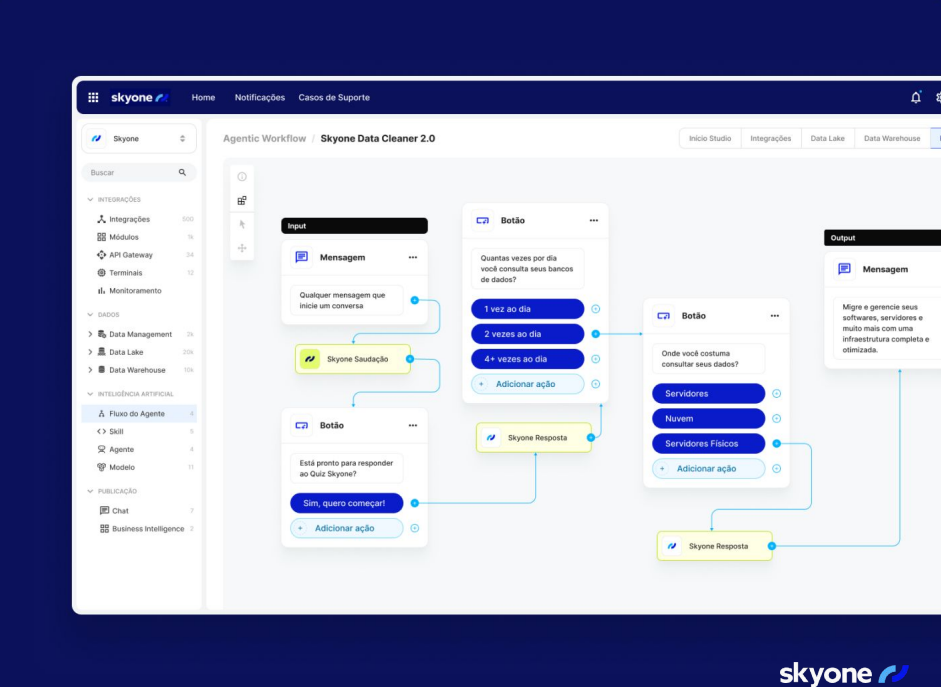
In this rapidly evolving environment, Skyone stands out with Skyone Studio , a complete solution for creating, publishing, and automating intelligent agents.
In addition to bringing together all resources on a single, intuitive platform Skyone Studio 's major differentiator is that it allows companies to create and operate AI agents based on their own data , securely, in a governed manner, and without exposing sensitive information to external or unknown environments.
This ensures complete control over automated workflows, while respecting the privacy, confidentiality, and sovereignty of corporate data.
This technology integrates four pillars that support the creation and use of high-performance AI agents:
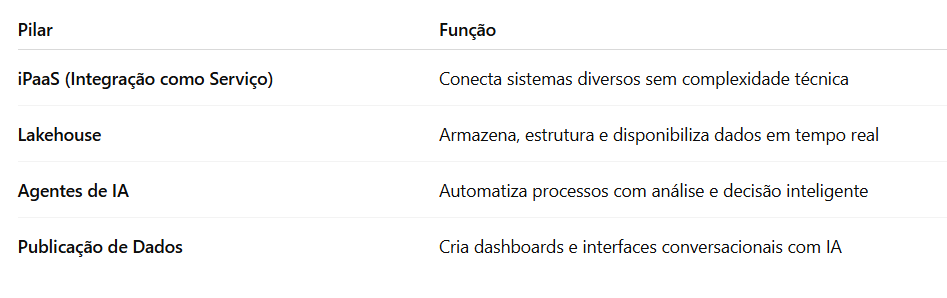
These components function as a complete infrastructure , connecting data, logic, and automation to develop agents that perform real actions in management systems, CRM, customer service, and other critical business processes.
Practical applications of AI agents in companies
With Skyone Studio, companies are building intelligent agents that transform their operations. See how this applies in practice:
1. Automating operational tasks with intelligent assistants
Imagine an agent that automates processes within the ERP system. It can generate financial reports based on up-to-date data, issue alerts about due dates, or send notifications to operational teams. In customer service environments, agents integrated with WhatsApp can access databases, identify clients, resolve requests, and trigger automated workflows without human intervention.
- Automation of routines within ERPs (e.g., SAP B1)
- WhatsApp-based customer service with data-driven decisions
- Generating automated reports via natural language commands
2. Integration between different operating systems
Integrating tools like CRM, ERP, and email marketing platforms is a recurring challenge. AI agents can intelligently connect these tools. For example, upon completing a sale in the CRM, an agent can update the ERP, send a welcome email, and trigger the finance department to issue an invoice, all in seconds.
- Creating workflows that integrate tools such as HubSpot, Zoho, Salesforce, and SAP
- KPI tracking and automated alerts
- Data synchronization between departments without human intervention
3. Automated dashboards and data-driven decisions in real time
Companies that handle large volumes of data can configure agents to monitor KPIs, issue deviation alerts, and take action based on predefined criteria. These agents also feed dashboards and automated reports, optimizing the analysis and response process.
- Development of dashboards for KPI monitoring
- Reduce operational costs by up to 90% through AI-powered automation.
- Ready-to-use dashboards that integrate with Power BI, Metabase, and other platforms

Read also: AI in autonomous agents: when technology resolves conflicts on its own.
Success stories with AI agents
The solution is already being used by companies such as Panasonic, Pague Menos, and Grupo Wish, with significant results
- Over 1.5 million monthly business flow executions
- 75% reduction in data processing time
- 45% increase in operational efficiency in the development of systems integrations

These numbers reinforce the idea that AI agents are no longer just a concept; they are now a business reality, especially when combined with a robust and secure platform.
Benefits of AI agents
Operational efficiency
Agents perform routine tasks with speed and accuracy, freeing up team time for strategic decisions.
Scalability
Multi-agent workflows can be duplicated, adapted, and applied to multiple departments or units within a company.
Personalization and contextual intelligence
With access to Lakehouse, agents learn and adapt to the user's context, offering more relevant responses and actions.
User-friendly interface
Thanks to Skyone Studio's low-code model, technology and business teams can create agents without relying on traditional IT.
Conclusion: What to expect from AI agents in the coming years
AI agents are no longer just promises; they are the protagonists of the new phase of digital transformation. With applications in diverse sectors and real impacts, they are becoming essential for companies that wish to innovate responsibly.
Now is the time to adopt this technology and secure a competitive advantage for your business.
Start creating your own AI agents now
Explore the potential of AI agents with a platform that transforms your systems into true intelligent decision centers.