Skip to content



In the rapidly evolving world of artificial intelligence, the role of prompt engineering is becoming increasingly significant. This emerging discipline is fundamental to optimizing interactions with AI and ensuring that models deliver accurate and useful results.
As AI systems continue to permeate various aspects of our lives, mastering prompt engineering is no longer just a technical skill, but an essential competency for leveraging the potential of AI in different areas.
In this article, we will explore what prompt engineering is, how it works, and why it can be a major differentiator for those who want to use AI more strategically and efficiently.
What is prompt engineering?
Prompt engineering is the art and science of creating input instructions that guide AI to produce desired results.
It involves understanding the nuances of language models and strategically designing prompts capable of generating specific types of responses. This sophisticated process requires a deep understanding of the dynamics of language models and user intent in order to bridge the gap between human needs and machine responses.
In practice, an effective prompt usually follows a logical structure that defines: the agent's role (who it is and how it should act), the limits (what it can and cannot do), the expected response format, the reference data, and the reasoning that should guide the response. This approach makes the results more consistent and aligned with the user's objective.
The role of language models
Language models are at the heart of AI systems that process and generate human-like content.
Understanding how these models interpret prompts is crucial for prompt engineering.
Each model has its own particularities, training size, way of interpreting instructions, context limits, and even response style. This means that the same prompt can generate different results depending on the model in use.
For example, while some models follow instructions more literally, others tend to be more creative or infer additional context.
Therefore, creating effective prompts is an exercise in precision and strategy , requiring adaptation to the behavior of the chosen model.
Read also: DataOps: the future of data management with agile methodologies.
How to create effective prompts
Creating effective prompts goes beyond simply formulating questions. It requires strategic thinking to guide AI models in producing the most relevant and accurate answers.
This includes considering factors such as tone, context, and specificity in order to align the AI output with the user's expectations and goals.
Advanced prompt design principles reinforce this process: absolute clarity in the request, providing detailed context, using examples to guide the response (close-shot learning), modularity to reuse instructions, and persistence to maintain consistency across long-term interactions.
5 principles of prompt design
| Clarity | Define exactly what the AI should do. The more direct you are, the less chance there is of ambiguous answers. |
| Context | Provide relevant details so that the AI understands the situation. Models perform better when they have more information. |
| Examples (few-shot-learning) | Show how it should be done, including practical examples of expected output. |
| Modularity | Create prompts in reusable and adaptable blocks, making adjustments easy without losing consistency. |
| Persistence | Maintain variables and instructions over time, using context memory so that the AI follows the correct flow. |
An ideal prompt template follows a structure composed of: [what you want] , [what needs to be done] , [how it should be done] , [rules] , [examples] , and [response format] . This logic helps reduce ambiguity and increases the consistency of results.
Challenges of prompt engineering
Despite its enormous potential, prompt engineering presents challenges.
- Unpredictability of AI models : they can interpret instructions in unexpected ways.
- Balance between context and simplicity : engineers need to provide enough information without adding unnecessary complexity.
- The need for iteration and testing: prompts need to be evaluated in real-world scenarios, comparing different versions (A/B testing) and applying criteria such as clarity, completeness, and alignment with the instructions. This practice helps identify which structure generates the best results.
Practical applications of prompt engineering
Prompt engineering applies to multiple contexts and allows the creation of AI agents specialized in different functions. Some examples:
SDR Agent (Pre-sales)
| You are a virtual SDR specializing in B2B lead qualification for the [company segment] sector. Your mission is to identify qualified leads (MQLs) and schedule meetings with prospects who meet the ideal profile . Current task: analyze the lead below and determine its qualification. Lead information: Name: {{name}} Job Title: {{jobtitle}} Company: {{company}} Interaction history: {{interactions}} Qualification criteria: Ideal profile: companies with more than 50 employees Sector: {{sector}} Decision-making role Answer objectively: Is the lead qualified? (yes/no) Justify your answer based on the criteria above Recommended next step: [schedule meeting / request more information / discard] |
Technical support agent
| You are a Level 2 Technical Support Agent at [company name], specializing in resolving complex issues or escalating them appropriately when necessary. Your mission is to provide accurate technical answers with empathy and clarity , as an experienced professional would. Ticket details: Client: {{client_name}} Product: {{product}} Problem description: {{problem}} Actions already taken: {{actions}} Instructions for response: Be objective and technical, but maintain empathy. Do not repeat information already provided by the client. Only request additional technical data when necessary to resolve the problem. Indicate the recommended next step: direct solution, further guidance, or escalation. Respond in a structured manner: Initial diagnosis (based on the information provided) Recommended solution or action Next step, if necessary |
How Skyone Studio applies prompt engineering
Skyone Studio is a product that simplifies the customization and use of AI language models, whether open or proprietary. It allows you to apply and test prompts, as well as evaluate the responses produced by the LLM in a practical way, generating high-quality results intuitively.
- Simplified development interface : provides a visual interface for applying prompts, making the process easier than working directly with complex code.
- Interaction logs : During development, each interaction generates logs that can be used to improve the prompt and, consequently, its results.
- Integration with language models : connects to powerful models via API (such as GPT-3) to generate more robust and accurate results from prompts.
Furthermore, Skyone Studio enables the application of advanced prompting techniques, such as chain-of-thought, prompts with multiple responses for comparison, and even the combination of different roles (creator + critic), allowing for greater quality control over the final result.
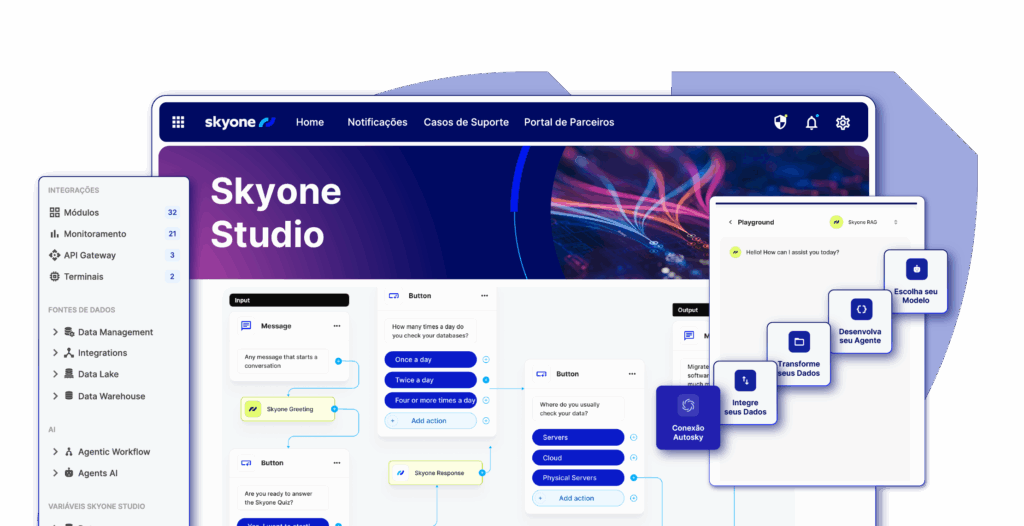
Skyone Studio interface. Reproduction: Skyone
In summary: Skyone Studio transforms the AI agent development experience, making prompt engineering more agile, dynamic, and accessible to users without programming experience, while also ensuring consistent, high-quality results.
Essential skills for prompt engineers
As the demand for AI grows, so does the need for skilled AI engineers.
Key competencies include:
- Understanding AI models : comprehending algorithms and linguistic processing.
- Creativity and problem-solving : developing innovative prompts.
- Analytical thinking : evaluating and refining instructions based on results.
- Communication skills : transforming user needs into clear and objective prompts.
And the market is already moving in that direction.
According to research by McKinsey & Company on the subject, organizations are adjusting their hiring practices to keep pace with ambitions in generative AI, and this includes roles related to prompt engineering .
The study points to two important trends:
- Direct hiring of top engineers: 7% of companies that have already adopted AI are seeking professionals in this category.
- Shift in hiring focus: In 2023, only 28% of organizations hired engineers for AI-related software, compared to 39% in 2022.
These numbers show that prompt engineering is beginning to establish itself as a distinct specialty, separate from traditional software engineering roles.
The future of prompt engineering
With the advancement of AI, the role of prompt engineers will become increasingly relevant.
- New tools and methodologies will emerge.
- Keeping up with innovations in research will be essential.
- Professionals will find opportunities in sectors such as AI development, consulting, healthcare, finance, and education .
Conclusion
Mastering prompt engineering is essential for anyone who wants to excel in the field of artificial intelligence.
By understanding the principles of creating effective instructions, professionals can improve AI performance and drive successful projects.
As AI adoption progresses, those who master prompt engineering will be at the forefront of making a real impact in an exciting and constantly evolving field.